Showing posts sorted by relevance for query m42. Sort by date Show all posts

Friday, November 24, 2006

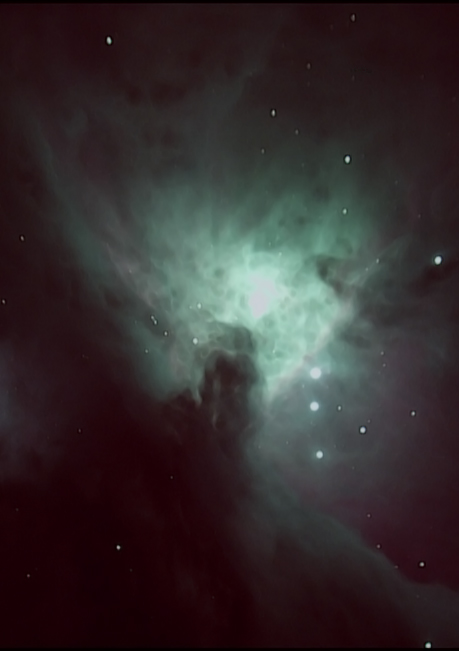
M42, The Orion Nebula Returns


Another rerun, this time a new version of M42, The Orion Nebula. Also here is M43, de Mairan's Nebula, a.k.a. the Running Man.

Shot this through the ST80 riding piggyback on the LX200. I learned a few new tricks since the last time I tried imaging with this scope.

This one's a composite of two images: the core of M42 is 30 x 10 seconds, the rest of the image is 30 x 30 seconds, Rebel XT.

Thursday, February 07, 2008

M42, The Orion Nebula (Modified Camera)


My buddy Daniel brought his new EOS 350D over last night. His camera is different from mine in that on his, the IR cutoff filter has been removed, so the camera is much more sensitive to the red colors in many nebula. Here's a stack of 20 (10 x 30 sec, 10 x 90 sec, 10 darks) of M42, the Orion Nebula with the AT80EDT. Compare the color to this version with my unmodified camera. This was also my first attempt at auto-guiding the LXD650 mount, and it looks like I need to adjust the settings a bit.

Friday, December 23, 2005

M42, the Orion Nebula


Click image for full-size.

It may not be the greatest M42 shot ever, but it's mine and I'm proud of it! Digital Rebel XT, 10" LX200@f/6.3, 8 x 30 sec, ISO 1600.

Saturday, January 22, 2011

M42, The Orion Nebula


No matter how many times I shoot this, I'm always amazed at how differently each one comes out.

Heritage Park Observatory, Cedar Park, TX
Exposure: 30 x 60 sec (30:00) @ ISO 800, 10 flat, 10 dark
Camera: Canon Digital Rebel XT (350D) (modified)
Scope: AT6RC, AT2FF field flattener
Mount: Meade LXD 650
Guider: Zenithstar 66, Meade DSI
Filter: None
Software: PHD Guiding, Nebulosity, Photoshop

Saturday, December 31, 2011

M42, The Orion Nebula


There's a reason this is one the most-photographed deep sky objects.


Heritage Park Observatory, Cedar Park, TX
Exposure: 20 x 30 sec (10:00) @ ISO 400, 10 x 300 sec (50:00) 10 flat, 10 dark
Camera: Canon Digital Rebel XT (350D) (modified)
Scope: AT6RC, AT2FF field flattener
Mount: CI-700
Guider: AT80EDT, Meade DSI
Filter: Astronomic CLS
Software: PHD Guiding, Nebulosity, Photoshop

Sunday, September 23, 2007

AT80EDT First Light

Last month my buddy Daniel gave me a Meade LXD650 German equatorial mount--basically the GEM version of the LX200 mount that I already use. Catch is, it doesn't work right. I dig into it and find the problem, a gear is turning on a shaft where it's not supposed to. I get that repaired, and $35 later I have a working* mount. But what am I going to do with it? I could de-fork the LX200, but it's non-trivial to get it back onto the forks and aligned. Or I could find a scope that's portable and designed for photography.

So that's what I did. I started researching apochromatic refractors. I've been getting nice shots with the big SCT, but it's limited to smaller targets due to the long focal length, so I'm looking for something with less focal length. I'm also trying to not spend a whole lot of money. So the Tele-Vue NP-101 that I really like is out: $3,700 is way out of my league. The Orion ED80 is a popular choice, and at $600 it's right in my sweet spot. But Barry has one, and while it's a very nice telescope, I want something different. The Meade Series 5000 ED APO triplet looks promising, but I never found an entirely positive review. Finally after a lot of research, I decide on the Astronomy Technologies AT80EDT. It's a triplet design, which means it uses three lenses instead of the usual two. It has a two-speed focuser like the one I added to the LX200, and comes in a nice case.

One Astromart "wanted" ad and a week later I'm the new owner of a nearly new AT80EDT. She's a beauty--white finish with grey, gold and green accents. The views through her are sweet, too. She rides just fine on the big LXD650 mount too. Here she is lit by the first quarter moon:


Friday night was the big night. Barry talked me into going up to the Eagle Eye Observatory for an overnighter, and what a night it was. Fridays are public night at the EEO, and there were about 40 guests there. The observatory operator had his hands full, so Barry & I took up the slack. He had his 10" LX200GPS going, while I put the binoviewers in the AT80EDT and aimed it at the Moon. I love it when someone looks into the scope and exclaims, "Oh my God!"

After the guests left and the Moon set, I hooked up the camera and went to work. I don't have the mount set up for autoguiding yet, so these are kinda rough. Each one is 40 x 30 seconds for just a 20-minute total exposure time. They're enough to get me really excited about imaging with this telescope though. Up first is M31, the Andromeda Galaxy:


Then there's M45, the Pleiades. I somehow managed to pull out some of the blue nebulosity even with the short exposure:


And last is M42, the Orion Nebula. Always a crowd-pleaser:

Monday, March 19, 2007

Messier Half-Marathon

A little background from Wikipedia:

The Messier objects are a set of astronomical objects catalogued by Charles Messier in his catalogue of Nebulae and Star Clusters first published in 1774. The original motivation behind the catalogue was that Messier was a comet hunter, and was frustrated by objects which resembled but were not comets. He therefore compiled a list of these objects.

The first edition covered 45 objects numbered M1 to M45. The total list consists of 110 objects, ranging from M1 to M110. The final catalogue was published in 1781 and printed in the Connaissance des Temps in 1784. Many of these objects are still known by their Messier number.

Because Messier lived and did his astronomical work in France in the Northern Hemisphere, the list he compiled contains only objects from the north celestial pole to a celestial latitude of about –35°. Many impressive Southern objects, such as the Large and Small Magellanic Clouds are excluded from the list. Because all of the Messier objects are visible with binoculars or small telescopes (under favorable conditions), they are popular viewing objects for amateur astronomers. In early spring, astronomers sometimes gather for "Messier marathons", when all of the objects can be viewed over a single night.


Well, that's just what I attempted Saturday night from Canyon of the Eagles. Trouble was that the weather--which started out great--turned to mush and the completely overcast by about 1:00 a.m. As a result I only made it through the first 45. Still, I saw a lot of things I hadn't seen before and want to go back and photograph.

Trudy & Ian came along for the first time. The boy had a pretty good time running around. He & Trudy wound up watching movies on the iBook in the tent after it got dark, but he did come look through the scope a couple of times.

Object Name Start Time Notes
M74 8:39:11 PM very faint
M77 8:43:15 PM ok
M33 8:53:56 PM large faint patch
M31 8:59:57 PM not bad for low in sky
M110 9:00:09 PM averted vision
M32 9:00:34 PM compact
M52 9:02:22 PM nice, easy
M103 9:13:01 PM pretty!
M34 9:16:19 PM big
M45 9:23:53 PM hello ladies! Better in ED80. Some nebulosity visible
M79 9:28:02 PM medium dim
M42 9:28:50 PM great in ED80; a,b,c,d,e & f easy with 13mm Nagler in 10"
M43 9:34:00 PM yup
M78 9:34:27 PM dull
M1 9:44:11 PM 3D-like, maybe texture with ultrablock?
M35 9:49:56 PM too big for 10"
M37 10:22:24 PM nice
M36 10:24:33 PM meh
M38 10:26:40 PM ok
M41 10:28:55 PM yup
M93 10:29:32 PM ok
M46 10:38:39 PM cool w/neb in cluster
M50 10:39:33 PM ok
M48 10:40:32 PM ok
M47 10:40:49 PM ok
M44 10:51:41 PM bah
M95 10:55:40 PM nice
M96 10:56:04 PM nice
M105 11:05:58 PM nice
M81 11:24:33 PM love 81 & 82
M82 11:25:23 PM love 81 & 82
M97 11:31:14 PM dim
M108 11:34:51 PM slim
M109 11:47:35 PM texture w/ averted vision
M40 11:50:37 PM why is this even on the list?
M106 11:55:14 PM definite shape
M94 12:07:50 AM hints of spiral?
M51 12:19:07 AM not bad. definite spiral, no bridge
M53 12:30:36 AM ok
M3 12:36:36 AM nice. tight center, loose edges
M85 12:37:43 AM hazy w/ bright center, like picture
M98 12:41:44 AM unremarkable
M99 12:45:53 AM something w/averted vision
M100 12:48:53 AM faint, no detail (pity)
M86 1:01:39 AM 84 & 86 together ok
M84 1:01:39 AM 84 & 86 together ok

Monday, December 21, 2009

M42, The Orion Nebula


Because you can never have too many pictures of the Orion Nebula.

Heritage Park Observatory, Cedar Park, TX
Exposure: 30 x 45 seconds
Camera: Modified Canon Digital Rebel XT (350D)
Scope: Meade 10" LX200, Meade f/6.3 focal reducer
Mount: Meade LX200
Guider: Short Tube 80, Meade DSI
Filter: Astronomik CLS
Software: PHD Guiding, Nebulosity, Photoshop

Monday, December 11, 2006

First Light: Meade DSI+Nebulosity

I'm borrowing Barry's DSI to try it out with Nebulosity and OS X, and boy, do I like it. I had tried this camera before using the Meade software, but it's Windows only, and, to me at least, it was everything that's wrong with Windows--ugly, counter-intuitive, and uncontrollable. Nebulosity, on the other hand, is a breeze to work with.

Anyway, here's the heart of M42, the Orion Nebula. This is a short, quickie job--just 10 frames X 15 sec at full gain, through the LX200 with the f/3.3 reducer.


Update: I reprocessed the capture using Drizzle, and found some more detail:

Saturday, December 24, 2005

M42 II


Turns out there was a lot more in there to be seen. Layered in PS CS2, layer masked out the core to keep it from blowing out, Noise Fixer filter.